Strawberry Supplementation Linked to Improved Cognition and Reduced Depressive Symptoms in Overweight Adults, Study Finds
07/07/2026 / By Chase Codewell

A randomized, double-blind, placebo-controlled trial found that 12 weeks of strawberry powder supplementation improved verbal learning and memory and reduced depressive symptoms in overweight adults aged 50 to 65 with mild cognitive decline, according to a study published in the journal Nutrients.
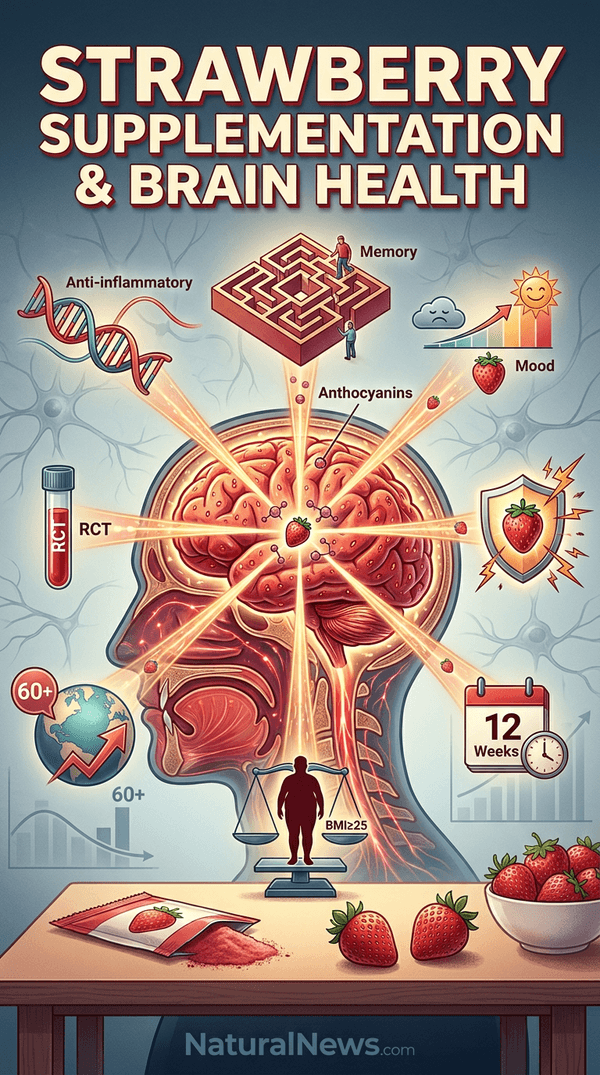
The study involved 30 participants who consumed a daily dose of strawberry powder containing 36.8 mg anthocyanins, equivalent to about one cup of fresh strawberries, researchers reported. Investigators from the University of Cincinnati found that the strawberry group showed a significant reduction in interference on verbal memory tests (p=0.02) and lower scores on the Beck Depression Inventory-II (p=0.04) compared to the placebo group.
The findings suggest that dietary intervention with strawberries may offer cognitive and mood benefits during the midlife preclinical period, according to the authors. The study was led by Robert Krikorian, Marcelle D. Shidler, and Suzanne S. Summer.
Background on Cognitive Decline and Berries
The global population over age 60 is growing at a faster rate than other age groups, with life expectancy expected to reach 77.1 years by 2050, according to a 2021 review in the Journal of Alzheimer’s Disease cited in the study background. Aging is associated with an increase in neurodegenerative diseases linked to cellular senescence of neurons and microglia, mitochondrial dysfunction, and chronic inflammation, as noted by researchers in a 2019 International Journal of Molecular Sciences article.
Berries, including strawberries, contain flavonoids and anthocyanins believed to activate cellular antioxidant protection, inhibit inflammatory gene expression, and scavenge free radicals, according to a 2019 review in Nutrients. Dietary intervention with strawberries has been associated with improved cognition, specifically working memory, and enhanced motor performance, as cited in a 2019 Food & Function study. Prior research has also shown that berry consumption can help reduce inflammation and health risks caused by obesity, according to NaturalNews.com. The Centers for Disease Control and Prevention has reported that over 40 percent of the American population over age 40 is currently obese, and obesity is a major risk factor for chronic degenerative diseases such as dementia and heart disease, according to NaturalNews.com [1].
Study Design and Methods
The trial recruited overweight men and women with a body mass index of 25 or greater, aged 50 to 65, who were experiencing mild cognitive decline, according to the study report. Participants were instructed to refrain from all berry fruit consumption and products for at least two weeks prior to enrollment and to collect a three-day diet record the week before enrollment and the week before the final study visit.
Thirty subjects were randomly assigned to the strawberry powder group (n=15) or a placebo group (n=15). They were instructed to mix one packet of assigned powder with water and consume it with the first meal of the day for 12 weeks. Each serving of strawberry powder contained 36.8 mg anthocyanins derived from about one cup of whole fresh strawberries, researchers said. The placebo powder was matched in color and appearance.
Primary outcomes included cognitive tests such as the Porteus Maze Test, Trail-Making Test, Controlled Oral Word Production, California Verbal Learning Test, and Spatial Paired Associate Learning Test. Mood was measured using the Beck Depression Inventory-II. Fasting blood samples were obtained to measure glucose, insulin, glycated hemoglobin, HOMA2-IR, triglycerides, and high-density lipoprotein cholesterol.
Key Results and Statistical Findings
The strawberry supplementation group experienced a significant reduction of interference in verbal learning and memory on the California Verbal Learning Test compared to the placebo group (p=0.02), according to the study authors. A lower mood disturbance was observed in the strawberry group compared to the placebo group on the Beck Depression Inventory-II (p=0.04), researchers reported.
No significant differences were observed between groups at the end of the intervention for fasting glucose (p=0.61), fasting insulin (p=0.29), HOMA2-IR (p=0.45), glycated hemoglobin (p=0.67), or the triglyceride-to-HDL ratio (p=0.85 and p=0.43), according to the paper. The authors noted that no pre-intervention differences were found regarding age, education, and general memory performance between groups, and no significant pre-intervention differences were observed for anthropometric and metabolic measures, except that the strawberry supplementation group exhibited a lower mean fasting glucose value compared to placebo at baseline (p=0.02).
Limitations and Future Research Directions
Study limitations include a small sample size of 30 participants and a trial duration of only 12 weeks, the authors noted in the paper. The researchers called for further investigation into the neuroprotective effects of strawberry consumption, particularly in larger and longer-term studies.
The study was published as an open-access article under a Creative Commons license, allowing free distribution. The findings align with prior research showing that berry polyphenols have beneficial effects on neuronal and behavioral aging, as highlighted in a 2006 review in the Journal of the Science of Food and Agriculture [2]. Natural approaches such as dietary interventions are gaining attention as alternatives to conventional pharmaceutical treatments for cognitive decline.
Conclusion and Implications
The results of the study suggest that daily strawberry supplementation may offer cognitive and mood benefits for overweight middle-aged adults with early cognitive decline, though more research is needed, according to the investigators. The strawberry powder provided anthocyanins equivalent to about one cup of fresh strawberries, indicating a feasible dietary intervention.
The findings underscore the potential of natural food-based interventions to support brain health. As noted in the book “Your Miracle Brain” by Jean Carper, keeping blood vessels free of clogging and damage and stimulating the brain by learning new things are essential to preserving brain function [3]. The current study adds to the evidence that dietary choices, including berry consumption, can play a role in cognitive aging.
References
- NaturalNews.com. “Research shows eating berries can help reduce inflammation and health risks caused by obesity.” June 23, 2022.
- FC Lau, B Shukitt-Hale, JA Joseph. “Beneficial effects of berry fruit polyphenols on neuronal and behavioral aging.” Journal of the Science of Food and Agriculture J Sci Food Agric 86:2251–2255, 2006.
- Jean Carper. “Your Miracle Brain.”
- Ralph E Carson. “The brain fix.”
- Mercola.com. “Strawberry Compound a Key to Good Memory.” July 24, 2017.
Explainer Infographic
Submit a correction >>
Tagged Under:
alternative medicine, antioxidants, beat depression, brain function, brain health, discoveries, food cures, food is medicine, food science, fruits, functional foods, grocery cures, health science, mental health, natural cures, natural health, natural medicine, Naturopathy, organics, remedies, research, Strawberries
This article may contain statements that reflect the opinion of the author
RECENT NEWS & ARTICLES